







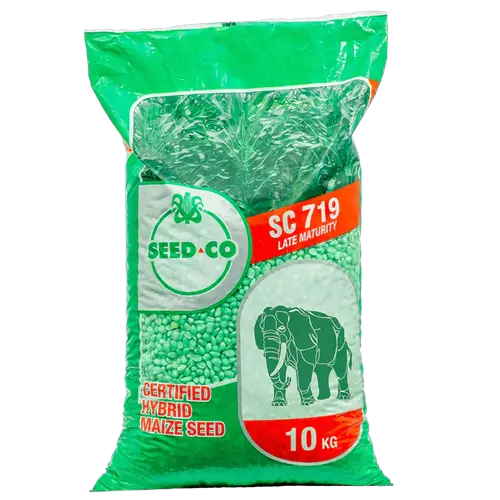
Botswana: SC 719 (TLOU) is a late-maturing white maize hybrid. The Botswana catalogue’s technical table records approximately 155 days to physiological maturity and a yield potential of up to 21 tonnes per hectare. It is positioned for high-potential production and forms part of Botswana’s late-maturity maize offering. The catalogue also places the late-maturing material strongly in irrigated and high-potential environments, with emphasis on standability, disease tolerance and silage suitability.
Malawi: SC 719 Njobvu is a late-maturing maize hybrid that reaches maturity in approximately 158 days. It produces white, semi-dent grain and has a yield potential of 12 tonnes per hectare, equivalent to approximately 250 × 50 kg bags. It has tolerance to GLS, NCLB and MSV. Uses include summer grain, cattle stover and silage. It is matched to Zones 3, 4 and 5.
Nigeria: SC 719 is a late-maturing white maize variety with a maturity period of approximately 120 days. It produces white, dent grain and has a yield potential of 10-12 tonnes per hectare. It is adapted to Forest and Savanna ecologies, particularly areas with a long rainfall period. SC 719 has a massive plant architecture suitable for animal fodder, long and fat cobs with higher-density planting, an excellent root system that makes it lodging tolerant, wide adaptability and large grain size suitable for mechanisation. Its recommended seed rate is 25 kg per hectare.
Zambia: SC 719 is a late-maturing white maize variety with a maturity period of approximately 142-148 days. It produces white, semi-dent grain and has a high yield potential of 12-14 tonnes per hectare, equivalent to approximately 240-280 × 50 kg bags. It has tolerance to Grey Leaf Spot, Northern Corn Leaf Spot and Maize Streak Virus, with moderate tolerance to Diplodia and Fusarium. SC 719 has good drought tolerance and very good standability. Its principal uses are summer grain, cattle stover and silage.
DRC: SC 719: A late maturing variety (142-148 days) with white, semi dent grain and a potential yield of 14 tonnes per hectare. It has reported tolerance to grey leaf spot, northern corn leaf blight, maize streak virus, and Diplodia and Fusarium ear rot. Its drought tolerance is rated very good and its standability good. It is listed for rainy season grain and livestock fodder in Zones 1-7.
Zimbabwe: SC 719 – Late-Maturing Maize Hybrid: SC 719 is a late-maturing maize hybrid that reaches physiological maturity in approximately 150-158 days, depending on altitude. It has a yield potential of up to 16.1 tonnes per hectare. Its major distinguishing traits include a high shelling percentage and excellent suitability for silage, making it relevant both for high-yield grain production and livestock-oriented farming systems.
Mozambique: SC 719 is a late-maturing maize hybrid with the highest stated maize yield potential in the supplied brochure: up to 20 tonnes per hectare under a good season at about 55,000 plants per hectare. It reaches physiological maturity at approximately 150-155 days.